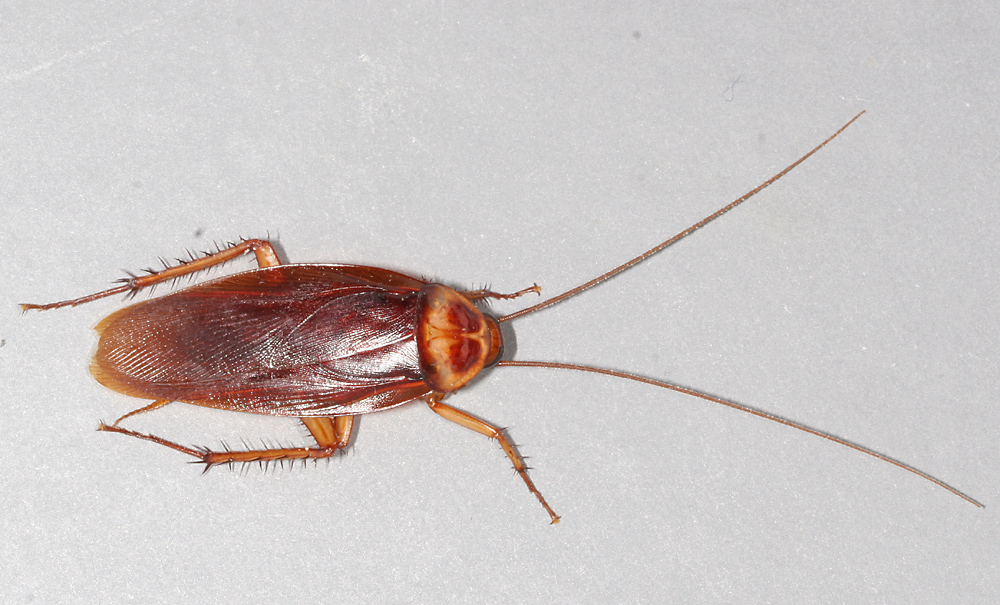

A reddish-brown silhouette darting through the darkness at night.
The American cockroach is one of the most widely recognized cockroach species in cities worldwide, known for its large size, extreme resilience, and remarkable adaptability. Despite its name, it did not originate in America. Today, it thrives in sewers and buildings, earning a reputation as one of the ultimate survivors of urban environments.
🧬 What Is the American Cockroach?
The American cockroach is among the largest cockroach species commonly encountered by humans.
- Class / Order / Family: Insecta / Blattodea / Blattidae
- Common name: American Cockroach
- Scientific name: Periplaneta americana
- Key traits
- Very large adult size
- Capable of short-distance flight
- Prefers warm, humid environments
👉 The name “American” comes from early scientific documentation in the United States; its true origin is believed to be Africa.
🌍 Distribution & Habitat
The American cockroach is found across tropical, subtropical, and urban regions worldwide.
- Common habitats
- Sewers and drainage systems
- Basements
- Boiler rooms
- Food storage areas
- Old or poorly maintained buildings
- Environmental preferences
- Warm temperatures (above ~25°C / 77°F)
- High humidity
- Dark, sheltered spaces
🌡️ Sewers and drain systems provide ideal living conditions for this species.
👀 Appearance & Physical Characteristics
- Body length: Approximately 3–4 cm (1.2–1.6 in)
- Color
- Reddish-brown to dark brown
- Wings
- Present in both males and females
- Head shield
- Light-colored margin on the pronotum
- Antennae
- Very long, used to sense vibration and air movement
✨ Their size and wings often make them appear more intimidating than other cockroach species.
🌙 Behavior & Activity
- Activity pattern
- Nocturnal
- Behavior
- Avoids light and human presence
- Rapid escape when threatened
- Movement
- Fast running
- Capable of short gliding or flying
🪳 Sudden flight is one reason this species causes strong fear reactions.
🍽️ Diet — Eats Almost Anything
The American cockroach is an extreme omnivore.
Common food sources
- Food scraps
- Paper and cardboard
- Soap
- Hair
- Decaying organic matter
- Dead animals
👉 This flexible diet allows it to survive in almost any environment.
🐣 Reproduction & Lifespan
- Reproductive method
- Produces egg cases (oothecae)
- Egg count
- About 14–16 eggs per egg case
- Breeding
- Year-round in favorable conditions
- Lifespan
- Approximately 1–2 years
✨ Although it reproduces more slowly than the German cockroach, it compensates with size, durability, and longevity.
⚠️ Health Risks & Hygiene Concerns
The American cockroach can act as a potential disease carrier.
Main concerns
- Spread of bacteria, fungi, and parasites
- Food contamination
- Triggers for allergies and asthma
- Psychological stress
👉 While it does not bite, it is considered a serious sanitary pest.
🧯 Prevention & Control
Household management
- Store food in sealed containers
- Maintain drains and plumbing
- Reduce moisture
- Seal cracks and entry points
Pest control
- Gel baits
- Sticky traps
- Professional pest control (often sewer-linked)
🪳 Because they often enter through drainage systems, building-wide management is essential.
🌱 Ecological Perspective
In natural environments, American cockroaches:
- Break down organic matter
- Contribute to nutrient cycling
However, in human living spaces, they are regarded as purely harmful pests.
🧡 Key Facts at a Glance
✔️ One of the largest urban cockroach species
✔️ Capable of flight
✔️ Extremely resilient and adaptable
✔️ A top-priority target for hygiene control
The American cockroach represents:
🪳 A survivor shaped by millions of years of evolution,
🪳 A shadow created by urban life, and
🪳 A mirror reflecting human living conditions.
Frequent sightings are rarely accidental—they often signal underlying environmental issues.
Understanding this insect and managing our surroundings effectively is the only way to end an unwanted coexistence with the American cockroach 🪳🚫
댓글 남기기