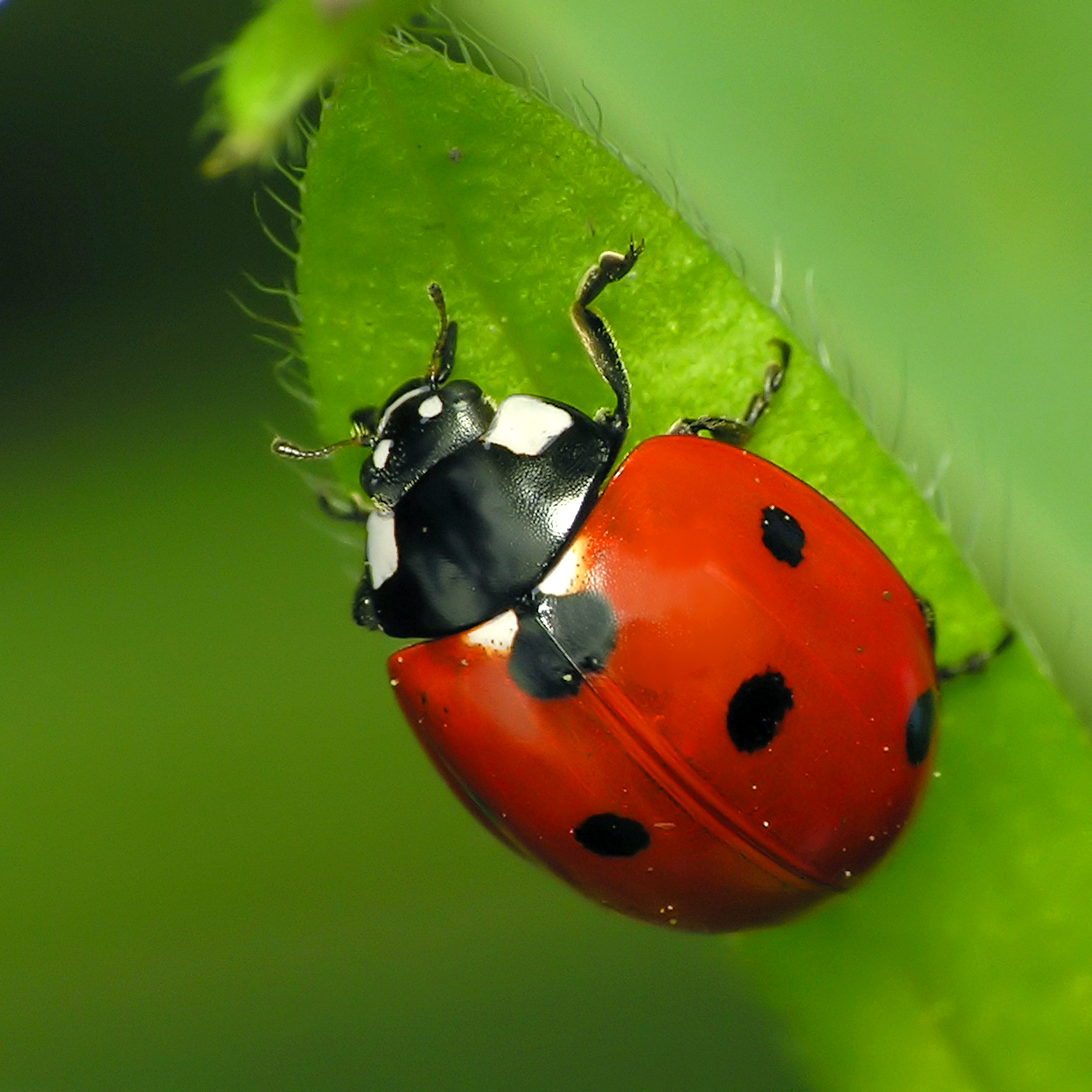

A bright red beetle gently landing on a green leaf, marked with seven bold black spots.
The seven-spotted ladybug is one of the most familiar and beloved ladybird species, long regarded as a symbol of good fortune. Behind its charming appearance, however, lies a powerful natural predator that plays a vital role in controlling agricultural pests.
🧬 What Is the Seven-Spotted Ladybug?
Named for the seven black spots on its red wing covers, the seven-spotted ladybug is widely distributed and highly valued for its ecological and agricultural importance.
- Class / Order / Family: Insecta / Coleoptera / Coccinellidae
- Scientific name: Coccinella septempunctata
- Name meaning
- “Seven-spotted” refers to the seven distinct markings on its back
👉 It is the most representative ladybug species in both Korea and Europe.
🌍 Distribution & Habitat
Thanks to its strong adaptability, the seven-spotted ladybug thrives in many environments.
- Distribution
- Korea
- Across Asia
- Europe
- North America (introduced)
- Common habitats
- Farmlands
- Grasslands
- Gardens
- Forest edges
🌱 It is most often found where aphids are abundant.
👀 Appearance & Physical Characteristics
- Body length: About 6–8 mm
- Coloration
- Bright red wing covers
- Seven black spots
- Head
- Black with white markings
- Wings
- Hard elytra covering functional flight wings
✨ The vivid colors serve as warning coloration, signaling predators that it is unpalatable.
🍽️ Diet — A Farmer’s Best Friend
The seven-spotted ladybug is a carnivorous insect.
Main prey
- Aphids
- Scale insects
- Mites
- Eggs of small pests
👉 A single adult can consume dozens of aphids per day, making it a natural pesticide.
🐣 Life Cycle & Reproduction
This species undergoes complete metamorphosis.
1️⃣ Egg
2️⃣ Larva
3️⃣ Pupa
4️⃣ Adult
- Egg laying
- Eggs are laid on the underside of leaves
- Larvae
- Consume even more pests than adults
- Lifespan
- Around one year
🐞 Even in the larval stage, it is already a highly effective predator.
🌙 Behavior & Defense Mechanisms
- Activity
- Diurnal (active during the day)
- Defense
- Releases yellow fluid from leg joints (reflex bleeding)
- The fluid has a bitter taste and strong odor
👉 This defense discourages predators such as birds and ants.
🌱 Ecological Importance
The seven-spotted ladybug plays a crucial role in ecosystems.
- Controls pest populations
- Reduces the need for chemical pesticides
- Stabilizes plant ecosystems
🐞 Despite its small size, it is a keystone beneficial insect in agriculture.
🧡 Why the Seven-Spotted Ladybug Is Special
✔️ A symbol of good luck
✔️ One of the most important beneficial insects
✔️ A key species for natural pest control
✔️ Loved by both children and adults
The seven-spotted ladybug represents:
🐞 A small but powerful guardian of nature,
🐞 A perfect blend of beauty and function, and
🐞 A bridge between humans and healthy ecosystems.
If you encounter one in your garden or in the wild,
take a moment to observe rather than chase it away.
Within its tiny wings lies the quiet strength of nature maintaining its own balance 🐞🌿
댓글 남기기