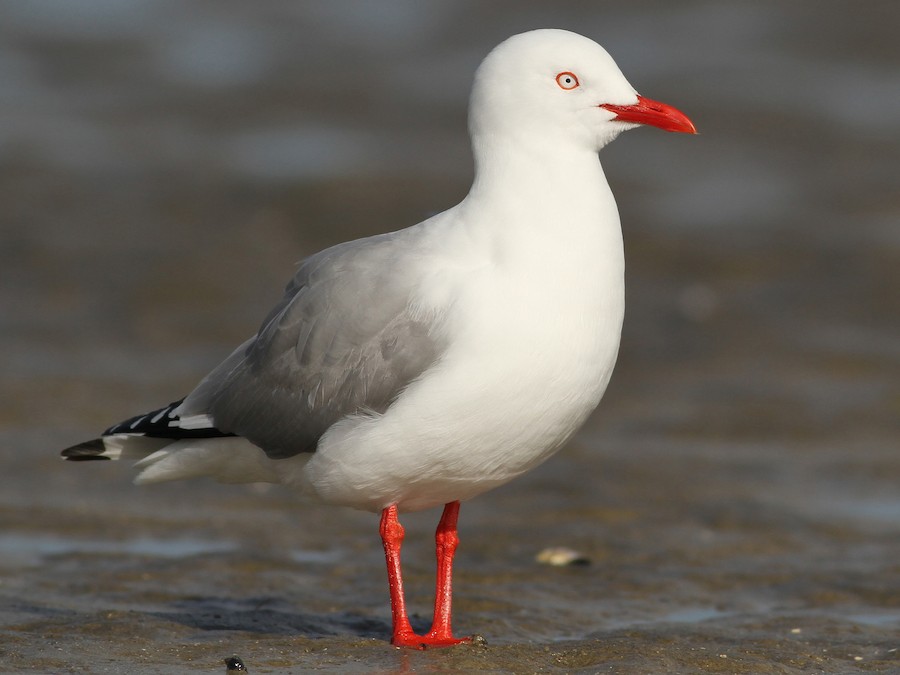
A bright red bill standing out against a clean white body,
and a light, graceful glide on ocean winds.
The red-billed gull catches the eye along coasts and islands with its neat appearance and lively behavior.
🧬 What Is the Red-billed Gull?
The red-billed gull is a small to medium-sized member of the gull family,
named for its vivid red bill, its most distinctive feature.
It is commonly found along Southern Hemisphere coastlines and is known for strong colonial breeding.
- Classification: Aves / Charadriiformes / Laridae
- Key traits
- Bright red bill and legs
- Relatively small body size
- Active social behavior
- Coastal and marine lifestyle
👉 Its clean color contrast makes it easy to distinguish from other gulls.
🌍 Distribution & Habitat
Red-billed gulls are most commonly found around New Zealand and southern Australia.
- Main range
- Throughout New Zealand
- Southern Australian coasts
- Nearby offshore islands
- Habitats
- Coastlines and beaches
- Rocky islands and cliffs
- Estuaries and harbors
🌊 While they prefer marine environments, they may also move inland when food is abundant.
👀 Appearance & Physical Characteristics
- Body length: About 35–40 cm (14–16 in)
- Wingspan: About 85–95 cm (33–37 in)
- Distinctive features
- White body with pale gray wings
- Black wing tips
- Bright red bill and legs
- Rounded head shape
✨ The simple yet bold color scheme is one of the species’ greatest charms.
🧠 Personality & Behavior
Red-billed gulls are social and energetic birds.
- Highly active in groups
- Strong territorial defense during breeding season
- Loud and competitive around food
- Excellent flyers
🐦 Usually tolerant, but remarkably bold when protecting nests.
🍽️ Diet & Feeding Habits
They are omnivorous, feeding on a wide range of items.
Main foods
- Small fish
- Crustaceans
- Mollusks
- Insects
- Human food scraps near settlements
👉 Their flexible diet contributes greatly to their adaptability and survival.
🐣 Breeding & Chick Rearing
- Breeding season: Spring to summer
- Breeding style
- Large colonial nesting
- Nests on islands or coastal rocks
- Clutch size: Usually 2–3 eggs
- Parental care
- Both parents incubate and feed chicks
- Chicks grow relatively quickly
🐣 Group nesting improves protection from predators.
🌱 Role in the Ecosystem
- Acts as a coastal scavenger
- Links different levels of the marine food web
- Serves as an indicator of coastal ecosystem health
🌍 Though common, the species plays an important role in maintaining environmental balance.
⚠️ Threats
- Habitat disturbance
- Increased human activity
- Climate-driven changes in food availability
👉 In some areas, breeding sites are actively managed and protected.
🧡 Why the Red-billed Gull Stands Out
✔️ Striking red bill
✔️ Energetic colonial lifestyle
✔️ Strong flight skills
✔️ A defining presence in coastal scenery
The red-billed gull is:
🐦 A blend of simplicity and bold beauty,
🐦 A master of adaptation between sea and people,
🐦 A small but vital guardian of coastal ecosystems.
When a flash of red passes between white wings along the shore,
the scene often becomes more vivid—
a moment made memorable by the presence of the red-billed gull.
댓글 남기기