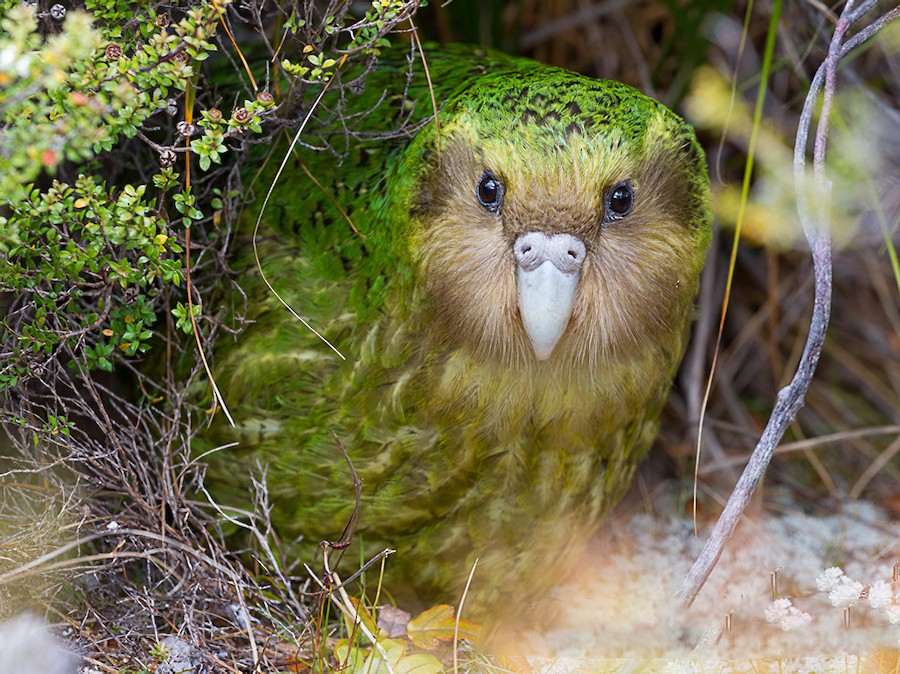

Soft, rounded feathers,
an owl-like face,
and a life that unfolds only after dark.
The kākāpō is one of the world’s most extraordinary parrots—and the only flightless parrot known to exist.
🧬 What Is the Kākāpō?
The kākāpō (Strigops habroptilus) is a nocturnal, heavy-bodied parrot found only in New Zealand. Its name comes from the Māori language and means “night parrot.”
- Class / Order / Family: Aves / Psittaciformes / Strigopidae
- Key traits
- The only flightless parrot
- Nocturnal lifestyle
- Exceptionally long lifespan
- Critically endangered
👉 A bird that chose a life without flight.
🌍 Distribution & Habitat
Once widespread across New Zealand, kākāpōs now survive only on protected, predator-free islands.
- Current habitat
- Offshore sanctuary islands of New Zealand
- Environment
- Dense native forests
- Cool, damp forest floors
🌲 A predator-free environment is absolutely essential for their survival.
👀 Appearance & Physical Characteristics
- Body length: About 58–64 cm (23–25 in)
- Weight: Up to 4 kg (8.8 lb), among the heaviest parrots
- Plumage
- Green with dark mottling for camouflage
- Face
- Rounded, owl-like facial disk
- Wings
- Not used for flight; aid in balance and climbing
✨ Though a bird, it moves more like a small mammal.
🌿 Diet & Feeding Habits
The kākāpō is a strict herbivore.
Main foods
- Leaves
- Fruits
- Seeds
- Flowers
- Roots
👉 The fruit of the rimu tree plays a crucial role in triggering breeding years.
🧠 Temperament & Behavior
- Gentle and curious
- Shows little fear of humans
- Excellent climber
- Tends to freeze rather than flee when threatened
🦜 These traits make it especially vulnerable to predators.
🎶 A Unique Breeding Strategy
Kākāpōs use a rare lek breeding system.
- Males dig shallow bowls in the ground
- They emit deep, booming calls to attract females
- Breeding occurs only every few years
👉 Extremely low reproductive rates make conservation critical.
🐣 Lifespan & Life History
- Lifespan: 60–90 years or more (among the longest-lived birds)
- Growth and reproduction are exceptionally slow
🕊️ Often called a “bird of time.”
⚠️ Endangered Status & Conservation
The kākāpō is one of the rarest birds on Earth.
Causes of decline
- Introduced predators (cats, stoats, rats)
- Habitat loss
- Low natural breeding success
Conservation efforts
- Every individual named and genetically monitored
- GPS tracking
- Assisted incubation and supplemental feeding
- Translocation to predator-free islands
👉 Every living kākāpō is under active human protection.
🧡 Why the Kākāpō Is Special
✔️ The only flightless parrot in the world
✔️ One of the rarest birds on the planet
✔️ Exceptionally long lifespan
✔️ A species that cannot survive without human care
The kākāpō is:
🦜 A life shaped by a different evolutionary choice,
🦜 A species living under human responsibility, and
🦜 A miracle of nature we must not lose.
The kākāpō asks us a quiet but profound question:
Are we prepared to take responsibility for the lives we have pushed to the edge?
The answer to that question may define not only the future of the kākāpō,
but the standards by which we protect nature itself 🌍🦜
댓글 남기기