

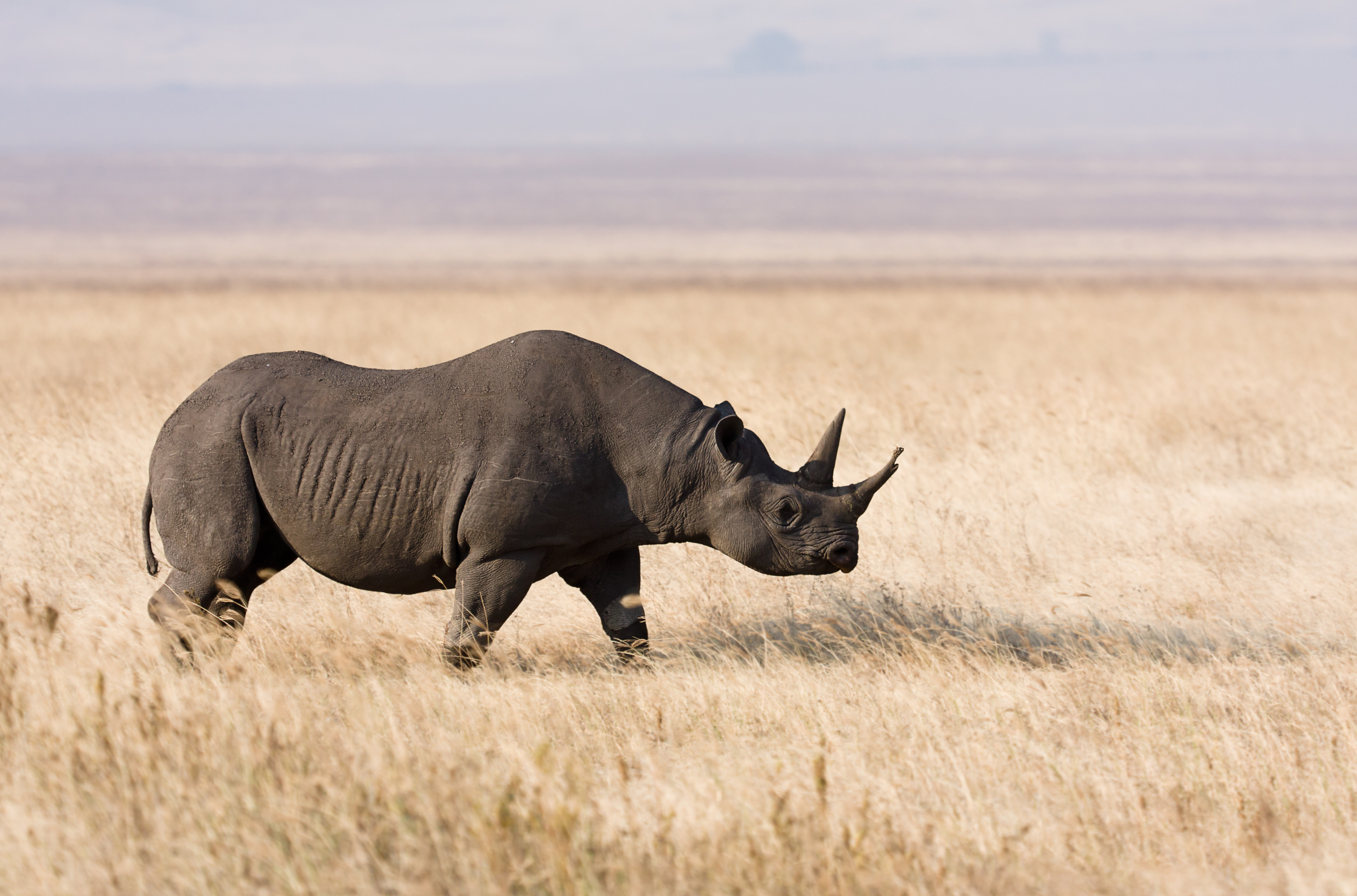
Two powerful horns,
thick, folded skin,
and a temperament that rarely yields.
The Southern Black Rhinoceros is one of Africa’s most striking megafauna—an animal defined by resilience, individuality, and an uncompromising will to survive.
🧬 What Is the Southern Black Rhinoceros?
The Southern Black Rhinoceros is a subspecies of the black rhinoceros. Despite its name, its skin is not black; the term “black” refers to the hooked shape of its upper lip, which distinguishes it from the wide-mouthed white rhinoceros.
- Class / Order / Family: Mammalia / Perissodactyla / Rhinocerotidae
- Key traits
- Hooked, prehensile upper lip
- Two horns
- Strong preference for solitary life
- Highly territorial behavior
👉 Its personality is often more striking than its appearance.
🌍 Distribution & Habitat
The Southern Black Rhinoceros is found in parts of southern and eastern Africa.
- Main regions
- South Africa
- Namibia
- Kenya
- Tanzania
- Habitats
- Savannas
- Bushlands
- Mixed woodland–grassland areas
🌾 Areas rich in shrubs and low trees provide ideal feeding grounds.
👀 Appearance & Physical Characteristics
- Body length: About 3–3.8 m (10–12.5 ft)
- Shoulder height: About 1.4–1.7 m (4.6–5.6 ft)
- Weight: About 800–1,400 kg (1,760–3,090 lb)
- Horns
- The front horn is longer and sharper
- Skin
- Thick, rough, and gray in color
✨ Though it appears slow, it can charge at surprising speed over short distances.
🌿 Diet & Feeding Habits
The Southern Black Rhinoceros is a browser, feeding mainly on leaves rather than grass.
Main foods
- Shrub leaves
- Twigs and branches
- New shoots
- Thorny plants
👉 Its hooked lip is perfectly adapted for grasping and stripping foliage.
🧠 Temperament & Behavior
- Known for being highly alert and aggressive
- Poor eyesight, but excellent hearing and sense of smell
- Mostly solitary
- May charge without warning if startled
🦏 It is often considered one of the most dangerous animals to humans in Africa.
🐣 Reproduction & Lifespan
- Gestation period: About 15 months
- Birth
- Usually a single calf
- Parental care
- The mother raises the calf alone
- Lifespan
- Around 35–40 years
👉 Slow reproduction makes population recovery difficult.
🌱 Ecological Role
The Southern Black Rhinoceros plays a vital role as a vegetation regulator.
- Controls excessive shrub growth
- Maintains balance among herbivores
- Increases habitat diversity
🌍 Savannas with rhinos differ in structure and plant composition.
⚠️ Endangered Status & Conservation
The Southern Black Rhinoceros is classified as endangered.
Major threats
- Poaching for horns
- Habitat destruction
- Human–wildlife conflict
👉 Thanks to international conservation efforts, some populations are slowly recovering, but strict protection remains essential.
🧡 Why the Southern Black Rhinoceros Matters
✔️ A unique evolutionary adaptation through lip shape
✔️ A powerful symbol of independence and strength
✔️ A keystone species for savanna ecosystems
✔️ A reminder of the cost of human greed
The Southern Black Rhinoceros is:
🦏 A creature that stubbornly holds its ground,
🦏 A silent guardian of the savanna, and
🦏 A warning light for wildlife conservation.
That such a massive animal can still face extinction
reminds us that this is not a failure of nature,
but the result of human choices.
Remembering—and protecting—the Southern Black Rhinoceros
is essential if it is to continue walking Africa’s ancient lands 🌍🦏
댓글 남기기