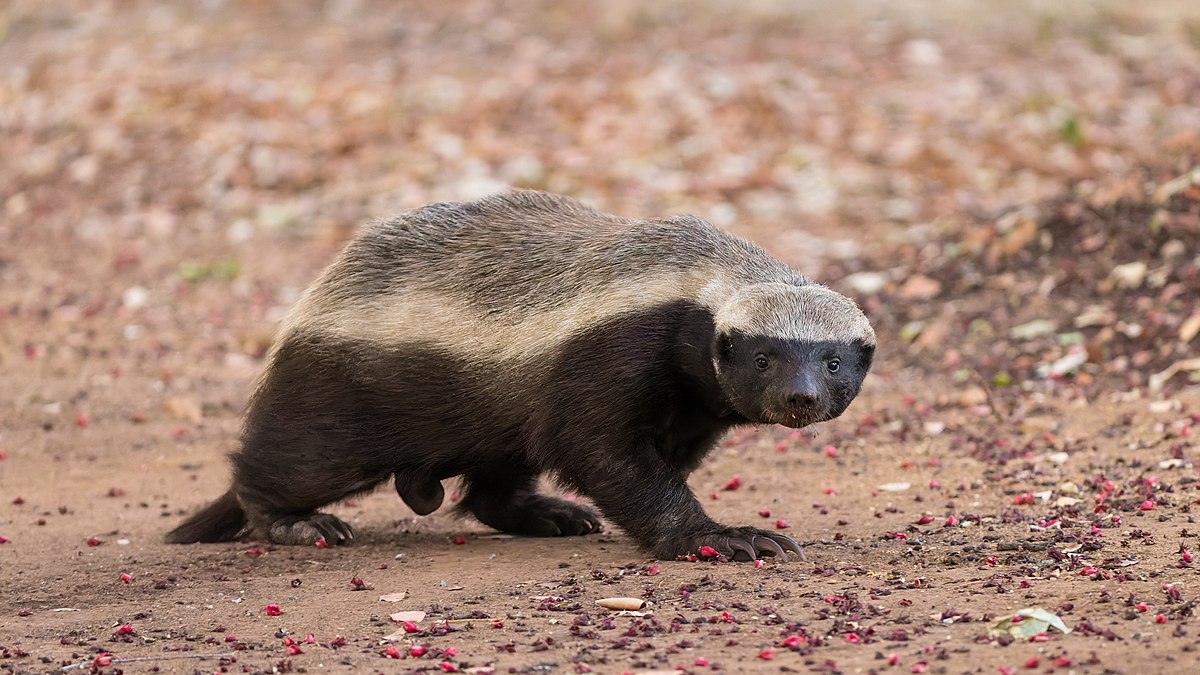
A small body,
yet a courage that never backs down from any opponent.
The honey badger is famously known as one of the bravest animals on Earth, displaying an extraordinary level of toughness and survival skill that far exceeds its size.
🧬 What Is the Honey Badger?
The honey badger belongs to the mustelid family, with the scientific name Mellivora capensis. In English-speaking regions it is also called the ratel. It is well known for its love of honey and its remarkably bold temperament.
- Class / Order / Family: Mammalia / Carnivora / Mustelidae
- Key traits
- Extremely fearless and aggressive when threatened
- Very thick, loose skin
- High intelligence and problem-solving ability
- Powerful jaws and long claws
👉 It truly earns the reputation of an animal that “does not know fear.”
🌍 Distribution & Habitat
Honey badgers are widely distributed across Africa, the Middle East, and the Indian subcontinent.
- Main regions
- Sub-Saharan Africa
- The Middle East
- India
- Habitats
- Savannas
- Deserts
- Forests
- Grasslands
🌍 Their adaptability allows them to survive in many different environments.
👀 Appearance & Physical Characteristics
- Body length: About 60–77 cm (24–30 in)
- Weight: About 7–14 kg (15–31 lb)
- Fur
- Grayish-white on the back
- Black on the belly and legs
- Skin
- Extremely thick and loose, reducing serious injury from bites or stings
- Claws
- Long and powerful, used for digging and fighting
✨ Despite its small size, its defensive abilities are exceptional.
🍯 Diet & Feeding Habits
Honey badgers are omnivorous, with a strong preference for animal prey.
Main foods
- Honey and bee larvae
- Snakes (including venomous species)
- Rodents
- Birds and eggs
- Insects
- Fruits
👉 There are documented cases of honey badgers surviving venomous snake bites, briefly collapsing, then recovering.
🧠 Temperament & Behavior
Honey badgers are highly independent and stubborn.
- Mostly solitary
- Extremely aggressive when provoked
- Instantly counterattack when threatened
- Excellent memory and learning ability
- Occasional reports of tool use
🦡 Even lions, hyenas, and leopards may be confronted rather than avoided.
🐣 Reproduction & Lifespan
- Gestation period: About 6–7 months
- Birth
- Usually 1–2 cubs
- Lifespan
- Wild: about 7–10 years
- In captivity: up to 20 years
👉 Their intense survival instincts are passed on to their offspring.
🌱 Ecological Role
Honey badgers act as powerful mid-level predators.
- Control rodent populations
- Reduce numbers of venomous snakes
- Help maintain ecological balance
🌍 Small in size, but significant in impact.
⚠️ Relationship With Humans
Honey badgers sometimes come into conflict with humans.
Common conflicts
- Attacking poultry or small livestock
- Destroying beehives
- Damaging property while foraging
👉 Uncontrolled killing can disrupt local ecosystems.
🧡 Why the Honey Badger Is Special
✔️ Legendary fearlessness
✔️ Resistance to venom and injury
✔️ High intelligence and adaptability
✔️ A symbol of “small but unstoppable”
The honey badger is:
🦡 A creature with courage far greater than its body,
🦡 A masterpiece of survival instinct, and
🦡 A living lesson in fearlessness.
The honey badger’s life reminds us that true strength
is not measured by size,
but by the determination to never give up—
a message delivered quietly, yet powerfully, by the wild 🦡🌍
댓글 남기기