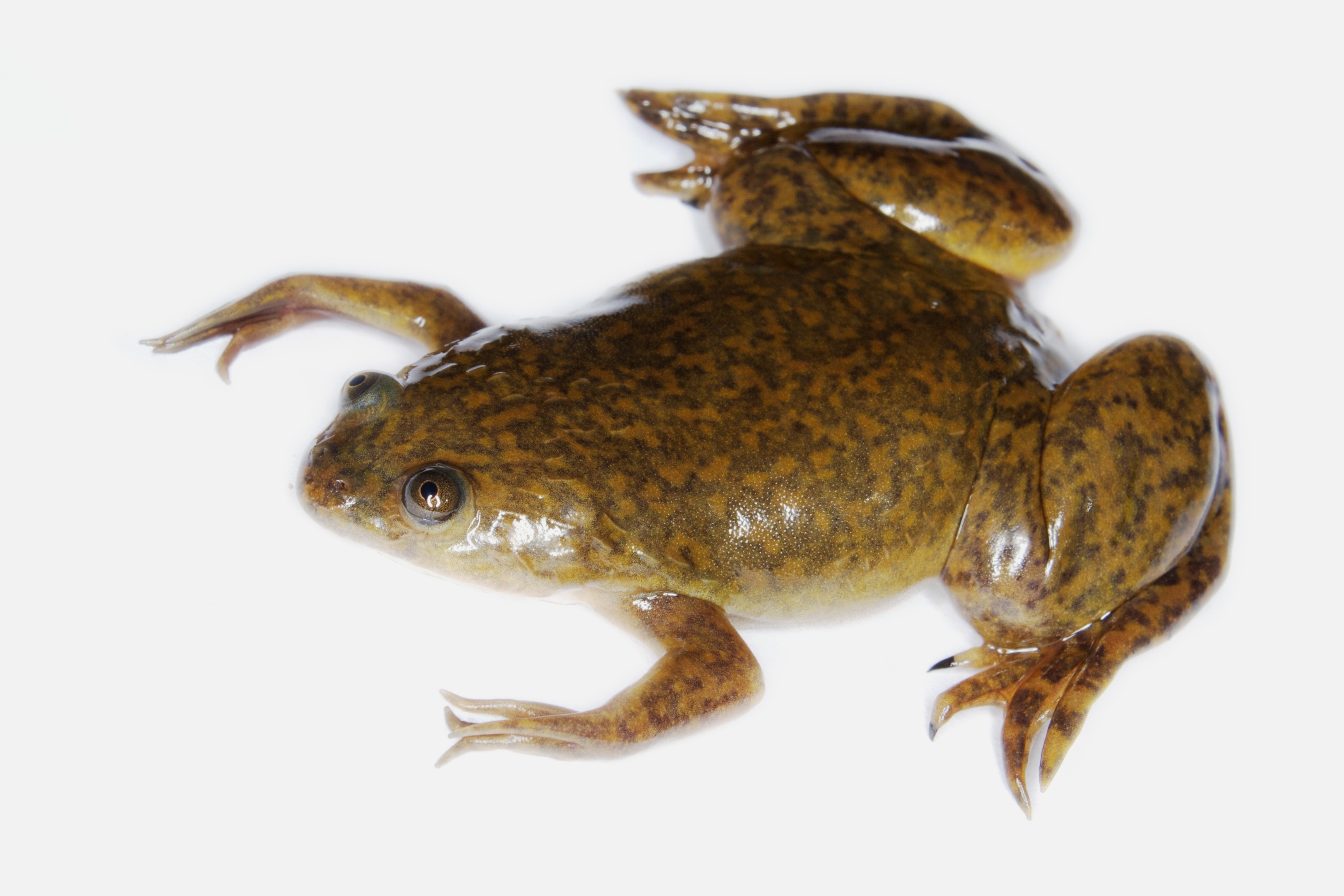

Sharp claws on the hind feet,
and a life spent entirely underwater.
The African clawed frog is a highly distinctive amphibian, notable not only for its unusual biology but also for its long-standing importance in scientific research.
🧬 What Is the African Clawed Frog?
The African clawed frog is a fully aquatic amphibian native to Africa. Unlike most frogs, it does not come onto land and spends its entire life in water.
- Class / Order / Family: Amphibia / Anura / Pipidae
- Scientific name: Xenopus laevis
- Key traits
- Three sharp claws on each hind foot
- No tongue
- Fully adapted to underwater life
- Remarkable hardiness and adaptability
👉 As its name suggests, it is literally a “frog with claws.”
🌍 Distribution & Habitat
Originally native to southern Africa, the African clawed frog is now found in many parts of the world.
- Native range
- South Africa
- Namibia
- Botswana
- Introduced range
- Europe
- The Americas
- Parts of Asia
- Habitats
- Ponds
- Marshes
- Lakes
- Slow-moving rivers
🌿 Its exceptional adaptability has allowed it to establish populations far beyond its original range.
👀 Appearance & Physical Characteristics
- Body length: About 5–13 cm (2–5 in)
- Body shape
- Flattened and streamlined
- Skin
- Smooth and slippery
- Olive-gray to brownish in color
- Eyes
- Positioned on the top of the head
- Distinctive features
- No tongue
- No teeth
- Lateral line system to detect vibrations
✨ Its body is perfectly optimized for underwater movement.
🍽️ Diet & Feeding Habits
The African clawed frog is mostly carnivorous, though technically omnivorous.
Main foods
- Aquatic insects
- Small fish
- Tadpoles
- Crustaceans
- Carrion (acting as a scavenger)
👉 It relies more on smell and vibration detection than on vision to locate food.
🧠 Behavior & Lifestyle
- Fully aquatic
- Cannot survive on land
- Activity pattern
- Mostly nocturnal
- Defense and feeding
- Uses claws to tear food or defend itself
- Communication
- Produces underwater vocalizations
🐸 Though it may appear sluggish, it can move very quickly when needed.
🐣 Reproduction & Life Cycle
The African clawed frog has a very high reproductive capacity.
- Breeding method
- External fertilization in water
- Eggs
- Hundreds to thousands laid at a time
- Development
- Egg → tadpole → metamorphosis → adult
- Breeding triggers
- Water temperature and quality
👉 This high reproductive rate is one reason it can become invasive outside its native range.
🔬 Role in Science & Medicine
The African clawed frog has played a major role in scientific history.
- Early pregnancy testing
- Developmental biology research
- Genetics studies
- Neurobiology and physiology experiments
🧪 Transparent embryos and rapid development made it an ideal laboratory model.
⚠️ Ecological Concerns
Because of its adaptability, the African clawed frog is considered an invasive species in some regions.
Ecological issues
- Competition with native amphibians
- Transmission of diseases (such as chytrid fungus)
- Disruption of local food webs
👉 Careful ecological management is required where it has been introduced.
🧡 Why the African Clawed Frog Is Unique
✔️ One of the few fully aquatic frogs
✔️ A clawed amphibian with unique anatomy
✔️ A major contributor to scientific research
✔️ Ecologically influential despite its small size
The African clawed frog is:
🐸 A survivor perfectly adapted to water,
🐸 A bridge between the laboratory and the natural world, and
🐸 A small amphibian with an outsized impact.
Moving quietly along the bottom of a pond,
it carries with it both the story of nature’s adaptability
and a legacy of scientific discovery—
living its life beneath the surface, yet influencing the world above 💧🐸
댓글 남기기