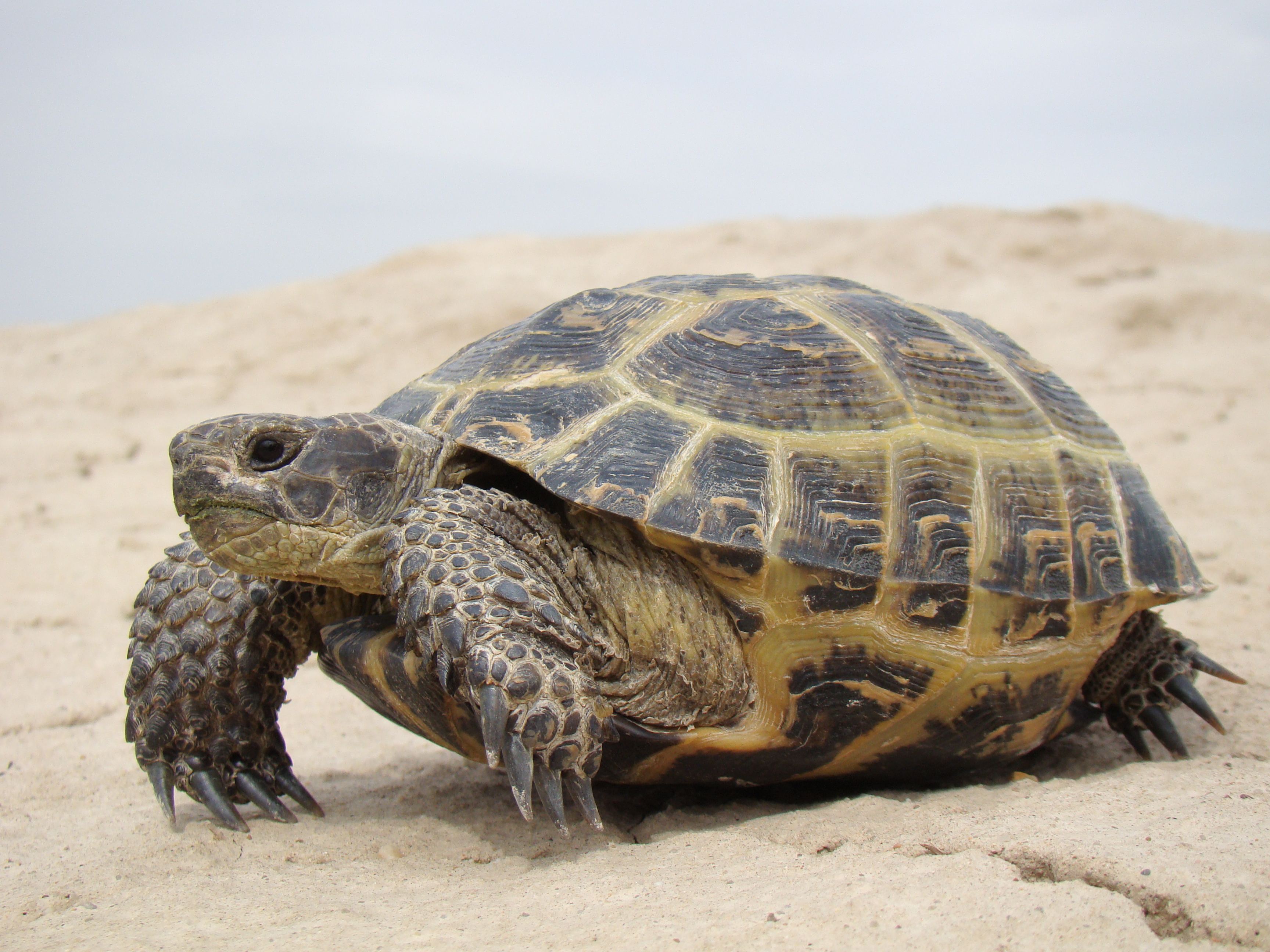


A sturdy shell, short powerful legs, and remarkable endurance.
Horsfield’s tortoise is a land tortoise built to survive harsh environments where temperatures swing dramatically. Known also as the Russian tortoise, it is admired for its toughness, compact size, and calm temperament.
🧬 What Is Horsfield’s Tortoise?
Horsfield’s tortoise is a terrestrial tortoise adapted to dry regions, notable for its ability to withstand both cold and heat. One of its most distinctive traits is having four toes on each foot.
- Class / Order / Family: Reptilia / Testudines / Testudinidae
- Scientific name: Testudo horsfieldii
- Key traits
- Four toes on each foot (most tortoises have five)
- Rounded, relatively flat shell
- Strong digging ability
- Exceptional tolerance of extreme climates
👉 It is a tortoise perfectly specialized for deserts and steppes.
🌍 Distribution & Habitat
Horsfield’s tortoise is widely distributed across Central Asia.
- Main range
- Southern Russia
- Kazakhstan
- Uzbekistan
- Afghanistan
- Parts of Mongolia
- Habitats
- Semi-deserts
- Dry steppes
- Sandy and gravelly terrain
🌵 It thrives in regions with little rainfall and large temperature fluctuations.
👀 Appearance & Physical Characteristics
- Shell length: About 15–25 cm (6–10 in)
- Weight: About 1–2 kg (2.2–4.4 lb)
- Shell color
- Yellowish-brown
- Olive tones
- Shell shape
- Rounded and fairly flat
- Limbs
- Short, thick, and strong
- Toes
- Four on both front and rear feet
✨ Overall, it gives a solid and stable impression.
🌿 Diet & Feeding Habits
Horsfield’s tortoise is strictly herbivorous.
Main foods
- Grasses
- Weeds
- Dandelion leaves
- Leafy greens
- Hay
👉 It avoids sugary fruits and prefers high-fiber, low-moisture plants, ideal for dry habitats.
🧠 Behavior & Lifestyle
- Diurnal
- Active during the day
- Excellent digger
- Uses burrows to escape heat and cold
- Balanced activity
- Alternates between walking and long rest periods
- Gentle temperament
- Rarely aggressive
🐢 When threatened, it fully retracts its head and limbs into its shell.
💤 Hibernation & Summer Dormancy
Horsfield’s tortoise can both hibernate and aestivate.
- Hibernation
- During cold winters
- Aestivation
- During extreme heat and drought
- Duration
- From several weeks to several months
👉 This dual dormancy is key to surviving extreme climates.
🐣 Reproduction & Growth
- Breeding season
- Spring to early summer
- Egg laying
- 2–6 eggs per clutch
- Incubation
- About 90–120 days
- Growth
- Relatively slow
🐢 Hatchlings are independent from birth.
🌱 Ecological Role
Horsfield’s tortoise is an important herbivore in arid ecosystems.
- Regulates plant growth
- Aids in seed dispersal
- Alters soil structure through burrowing
🌍 Despite its small size, its ecological impact is significant.
⚠️ Threats & Conservation
- Habitat loss
- Illegal capture and trade
- Climate change
👉 In some regions, it is protected, and international trade is regulated.
🧡 Why Horsfield’s Tortoise Is Special
✔️ Exceptionally adapted to extreme environments
✔️ Unique four-toed feet
✔️ Capable of both hibernation and aestivation
✔️ Tough yet gentle in nature
Horsfield’s tortoise is:
🐢 A survival expert of deserts and steppes,
🐢 A quiet but resilient land tortoise, and
🐢 A creature that lives life at its own slow pace.
In a fast-changing world, this tortoise moves steadily and patiently—
a gentle reminder that endurance and consistency can be powerful virtues 🐢🌿
답글 남기기