

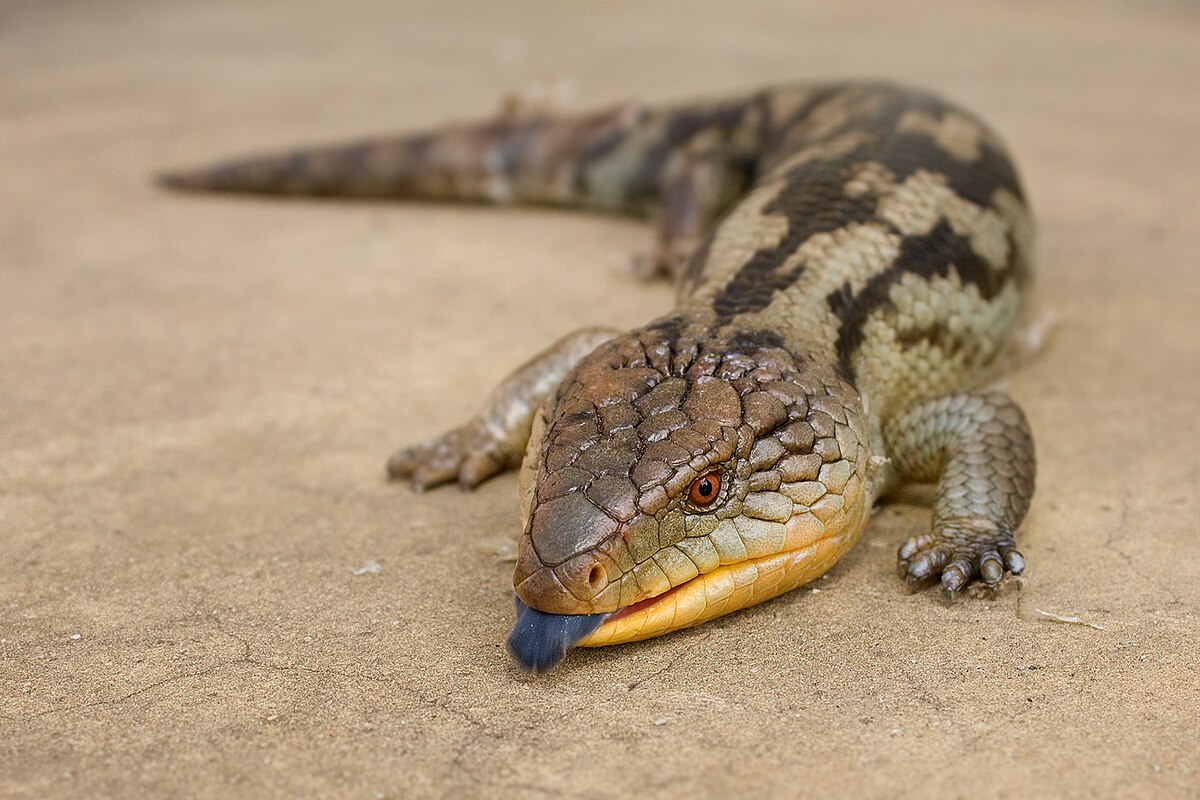
The moment it opens its mouth, a vivid blue tongue flashes into view.
The blue-tongued skink is known for this unique defensive display, its sturdy, rounded body, and a temperament that is surprisingly calm for a large lizard.
🧬 What Is a Blue-tongued Skink?
Blue-tongued skinks belong to the skink family and are instantly recognizable by their bright blue tongues, which they use to deter predators.
- Order / Family: Squamata / Scincidae
- Key traits
- Displays a blue tongue when threatened
- Thick, snake-like body with short legs
- Generally slow-moving and non-aggressive
👉 The blue tongue acts as a visual warning, startling predators long enough for the skink to escape.
🌍 Habitat & Distribution
Blue-tongued skinks are native mainly to Australia, with some species found in Indonesia.
- Common habitats
- Grasslands
- Shrublands
- Forest edges
- Areas near farmland
- Lifestyle
- Primarily ground-dwelling
- Adaptable to various environments
🌱 Their flexibility helps them thrive across diverse landscapes.
👀 Appearance & Physical Characteristics
- Length: ~45–60 cm (18–24 in)
- Weight: ~300–700 g (10–25 oz)
- Body
- Thick, muscular torso
- Short, sturdy legs
- Relatively short tail
- Coloration
- Brown, gray, or tan with bands or blotches
- Tongue
- Bright, unmistakable blue
✨ Though they may look sluggish, their build provides excellent defense and durability.
🧠 Temperament & Behavior
Blue-tongued skinks are known for being docile and calm.
- Personality
- Low aggression
- Tolerant of human presence
- Defensive behavior
- Inflates the body
- Opens the mouth to display the blue tongue
- Activity pattern
- Diurnal (active during the day)
👉 With proper handling, they are often considered one of the most manageable large lizards.
🍎 Diet
Blue-tongued skinks are omnivores.
Typical foods
- Insects
- Snails and slugs
- Fruits
- Vegetables
- Occasionally small vertebrates
🥗 A balanced diet is essential—too much protein or sugar can lead to health problems.
🐣 Reproduction & Lifespan
- Reproductive method
- Viviparous (gives birth to live young)
- Litter size
- About 5–20 offspring
- Lifespan
- ~15 years in the wild
- 20 years or more in captivity
✨ They are relatively long-lived compared to many other lizards.
🏠 Care Considerations (for Captive Skinks)
- Temperature
- Daytime: 28–32 °C (82–90 °F)
- Basking spot: ~35 °C (95 °F)
- Humidity
- Medium to low, depending on species
- Substrate
- Coconut fiber, soil mixes, or paper
- Lighting
- UVB lighting is essential
⚠️ Poor temperature or diet management can cause metabolic bone disease.
🌱 Role in the Ecosystem
- Controls insect and snail populations
- Helps disperse seeds through fruit consumption
- Serves as a mid-level predator
👉 Blue-tongued skinks contribute to balance in ground-level ecosystems.
🧡 Why the Blue-tongued Skink Is Special
✔️ One of the few lizards with a bright blue tongue
✔️ Calm and tolerant temperament
✔️ Unique live-bearing reproduction
✔️ Popular and respected reptile among enthusiasts
The blue-tongued skink represents:
🦎 A reptile that warns before it fights,
🦎 A slow mover built for long survival, and
🦎 A species capable of peaceful coexistence with humans.
That flash of blue is not an act of aggression—it is an honest signal saying,
“Please keep your distance.”
With proper understanding and care, the blue-tongued skink can be a quiet, resilient, and fascinating companion 🦎💙
댓글 남기기