
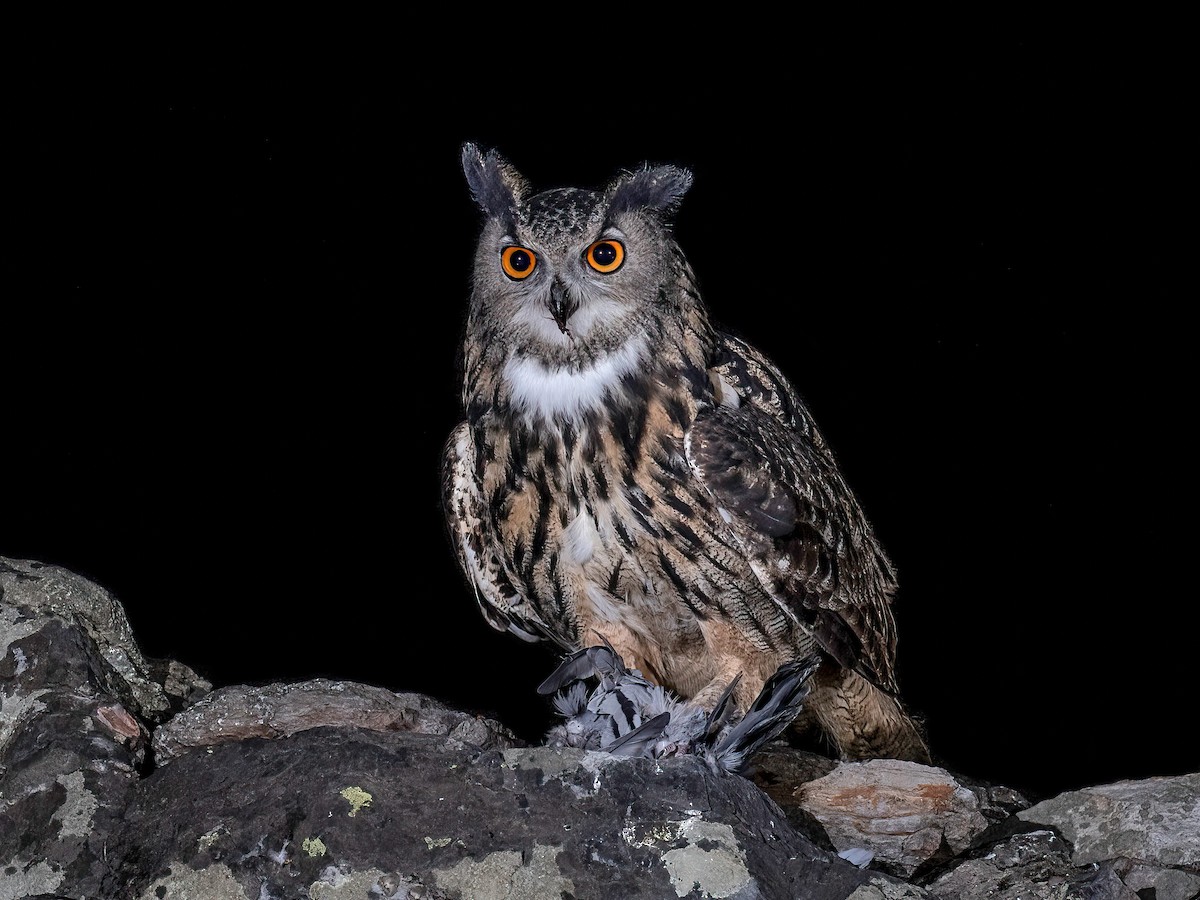

In forests and on rocky cliffs after dark, a deep, resonant call announces a formidable presence.
The Eurasian eagle owl is one of the largest owls in the world, an apex nocturnal predator equipped with immense strength and razor-sharp senses.
🧬 What Is the Eurasian Eagle Owl?
Among owls, the Eurasian eagle owl stands out for its size, power, and dominance.
True to its name, it rivals daytime raptors in both presence and hunting ability.
- Order / Family: Strigiformes / Strigidae
- Key traits
- One of the largest owl species
- Powerful talons and beak
- Exceptional night vision and hearing
👉 It is often regarded as the undisputed apex predator of the night.
🌍 Habitat & Distribution
The Eurasian eagle owl is widely distributed across Eurasia.
- Main range
- Europe
- Central Asia
- Siberia
- The Korean Peninsula
- Preferred habitats
- Forests
- Rocky cliffs
- Valleys
- Remote, undisturbed areas
🌲 Landscapes that combine forests and cliffs are especially favored.
👀 Appearance & Physical Characteristics
- Body length: ~60–75 cm (24–30 in)
- Wingspan: Up to 180 cm (71 in) or more
- Weight: ~2–4 kg (4.4–8.8 lb)
- Eyes
- Large, orange to amber
- Plumage
- Brown and gray with bold mottling
- Ear tufts
- Prominent feather tufts on the head (not actual ears)
✨ Its massive build and piercing gaze make its predatory nature instantly apparent.
🌙 Behavior & Lifestyle
- Activity pattern
- Primarily nocturnal
- Social structure
- Solitary
- Maintains large territories
- Flight
- Nearly silent due to specialized feathers
- Vocalization
- Deep, low hoots used for territorial calls
🦉 Its silent flight allows it to approach prey undetected.
🐇 Diet & Hunting Ability
The Eurasian eagle owl is a strict carnivore.
Common prey
- Rabbits
- Rodents
- Birds
- Reptiles
- Occasionally other raptors
Hunting style
- Ambushes from perches on trees or rocks
- Powerful swoops to seize prey
- Immense grip strength delivers a quick kill
👉 Once caught, prey is rarely able to escape.
🐣 Breeding & Development
- Breeding season: Late winter to early spring
- Nest sites
- Rock ledges
- Cliff crevices
- Reused old nests
- Clutch size: 1–4 eggs
- Parental care
- Female incubates eggs
- Male supplies food
✨ Chicks grow slowly, but survivors mature into top-tier nocturnal hunters.
⚠️ Threats & Conservation Status
The Eurasian eagle owl is protected in many regions, though threats remain.
Major threats
- Habitat loss
- Illegal hunting and poisoning
- Collisions with power lines
- Increasing human disturbance
📉 Population trends vary by region.
In Korea, the species is designated a Natural Monument and legally protected.
🌱 Role in the Ecosystem
- Controls populations of rodents and rabbits
- Maintains balance within food webs
- Indicator of healthy forest ecosystems
👉 The eagle owl acts as a guardian of ecological balance at night.
🧡 Why the Eurasian Eagle Owl Is Special
✔️ One of the world’s largest owls
✔️ Exceptional hunting power
✔️ Master of silent flight
✔️ Keystone predator of nocturnal ecosystems
The Eurasian eagle owl represents:
🦉 The king of the night,
🦉 A silent ruler of forests and cliffs, and
🦉 Nature’s most powerful owl.
When an eagle owl glides soundlessly through the darkness,
it signals that the land below is still wild and alive.
Protecting this species means protecting not just one bird,
but the entire nocturnal ecosystem it helps sustain 🌙🦉
댓글 남기기