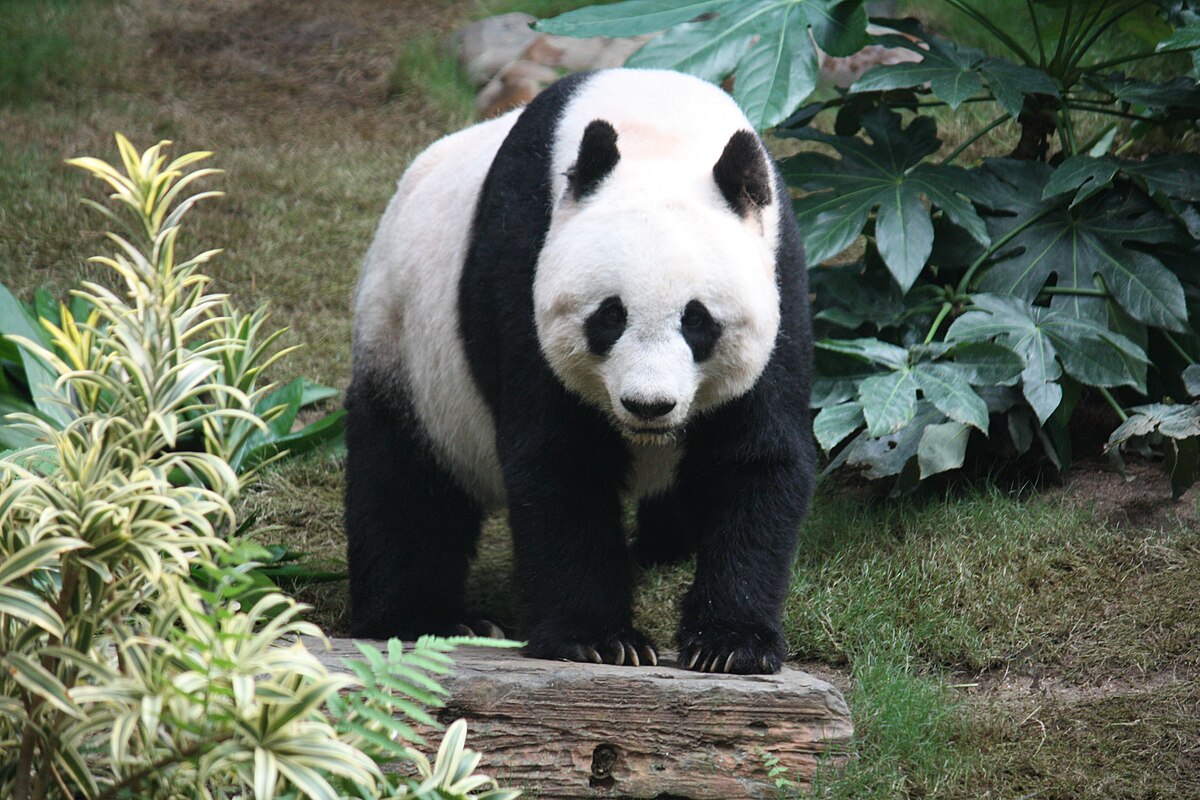


A round face with black eye patches, slow and gentle movements, and front paws firmly gripping bamboo.
The giant panda is one of the world’s most beloved animals. Behind its adorable appearance lies a delicate ecology and a unique evolutionary story.
🧬 What Is a Giant Panda?
- Order / Family: Carnivora / Ursidae (bear family)
- Scientific name: Ailuropoda melanoleuca
- Nicknames: Bamboo bear, symbol of peace
👉 Although classified as a bear, the giant panda is exceptional because its diet consists almost entirely of bamboo.
🌍 Habitat & Distribution
Giant pandas are found only in mountainous bamboo forests of central China.
- Main regions
- Sichuan Province
- Shaanxi Province
- Gansu Province
- Environmental conditions
- Elevation: ~1,200–3,400 m (3,900–11,000 ft)
- Cool, moist climate
- Dense bamboo growth
🌿 Because their range is so limited, pandas are highly sensitive to environmental change.
👀 Physical Characteristics
- Body length: ~1.2–1.8 m (4–6 ft)
- Weight: Adults ~70–120 kg (155–265 lb)
- Coloration
- Body: white
- Eyes, ears, shoulders, legs: black
- Forepaws
- A “pseudo-thumb” formed from an enlarged wrist bone
- Specially adapted for gripping bamboo
✨ The black-and-white pattern also provides natural camouflage in snowy and forested environments.
🍃 Diet — A Bear That Lives on Bamboo
Giant pandas spend most of their day eating.
- Main foods
- Bamboo stalks
- Leaves
- Shoots
- Daily intake
- About 12–38 kg (26–84 lb) of bamboo
- Dietary traits
- Low digestive efficiency
- Occasionally eats small fruits or animals, but rarely
👉 Over 99% of their diet is bamboo.
🧠 Behavior & Personality
Giant pandas are generally gentle and solitary animals.
Behavioral traits
- Prefer living alone
- Low aggression
- Low activity levels
- Enjoy climbing trees and rolling on the ground
🐼 Their slow pace is often mistaken for laziness, but it is actually an energy-saving strategy.
🐣 Reproduction & Development
Pandas are famously difficult to breed due to their very short fertile period.
- Female fertility: Only a few days each year
- Gestation period: ~95–160 days (delayed implantation)
- Birth
- Usually one cub (twins are rare)
- Newborns
- Weigh about 100 g (3.5 oz) at birth
- Extremely small compared to the mother
✨ Panda cubs require intensive maternal care to survive.
⚠️ Threats & Conservation Status
Giant pandas were once a global symbol of endangered species.
Major threats
- Habitat loss
- Decline of bamboo forests
- Climate change
- Naturally low reproduction rates
📈 Thanks to long-term conservation efforts and protected reserves, panda populations are slowly recovering.
🌱 Role in the Ecosystem
- Help maintain bamboo forest dynamics
- Act as an umbrella species
- Protecting pandas also safeguards many other forest species
👉 Saving pandas means protecting entire mountain ecosystems.
🧡 Why Giant Pandas Are So Loved
✔️ Unique black-and-white appearance
✔️ Gentle, peaceful image
✔️ A global symbol of conservation success
✔️ An ambassador for wildlife protection
The giant panda represents:
🐼 The beauty of living slowly,
🐼 Harmony between nature and life, and
🐼 The importance of protection and coexistence.
Loved not only for its cuteness, the giant panda reminds us of a deeper truth—
when we respect forests and natural balance, life continues to thrive.
As long as bamboo forests remain,
the giant panda will keep quietly chewing peace in the heart of the mountains 🌿🐼
댓글 남기기