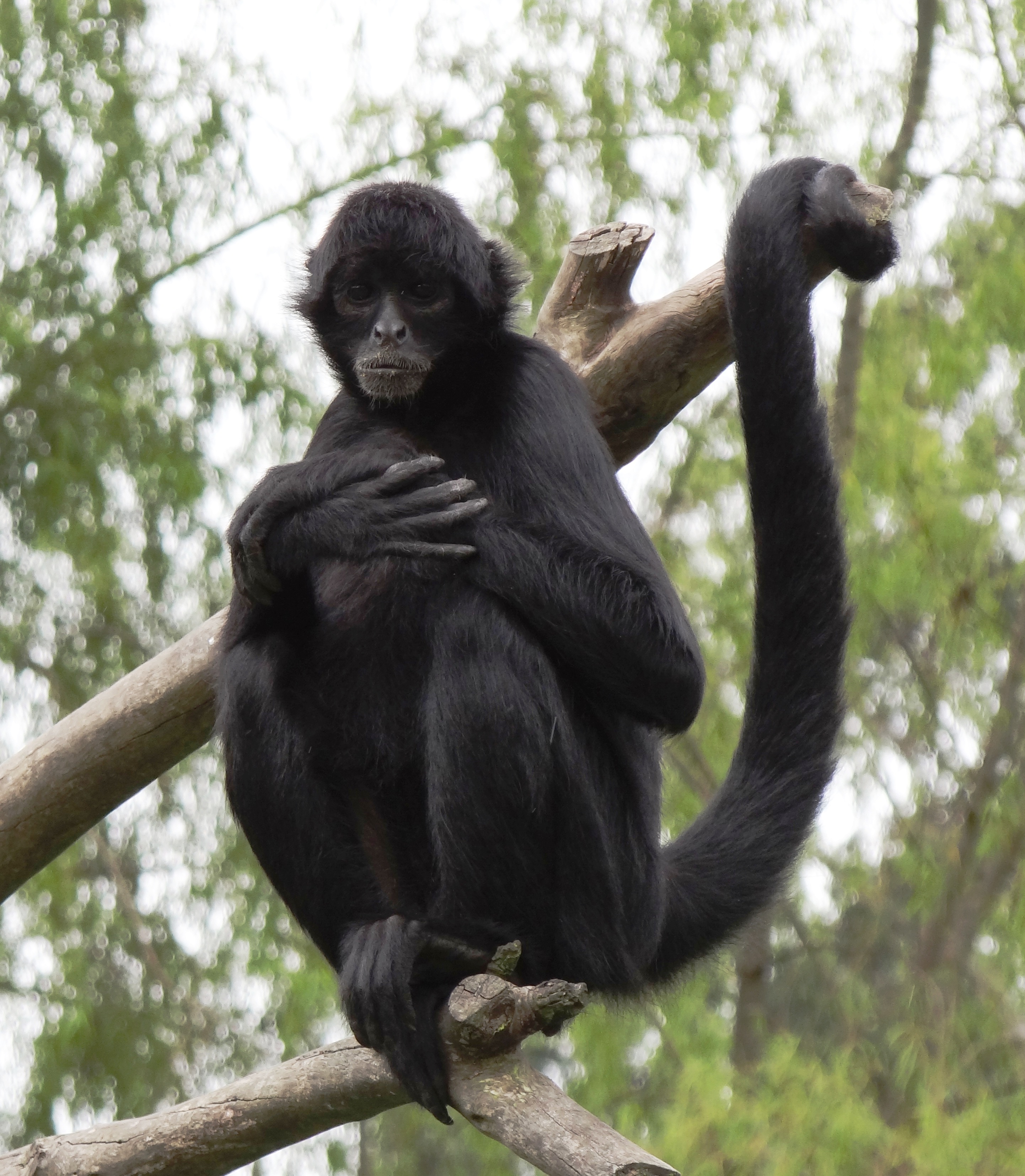


Long, slender limbs, a tail more important than hands, and movement that looks like flying between trees.
The Spider Monkey lives up to its name with spider-like agility. Dwelling high in tropical rainforest canopies, it is a true master of aerial acrobatics.
🧬 What Is a Spider Monkey?
- Order / Family: Primates / Atelidae
- Genus: Ateles
- Common name: Spider Monkey
- Name origin: Named for its long, thin limbs that resemble a spider
👉 The spider monkey’s defining feature is its fully prehensile tail.
🌍 Habitat & Distribution
Spider monkeys are native to Central and South America.
- Primary habitats
- Tropical rainforests
- Subtropical forests
- Riverine forests
- Living zone
- Upper forest canopy
🌳 They spend most of their lives high in the trees, rarely coming to the ground.
👀 Physical Characteristics
- Body length: ~35–65 cm (14–26 in)
- Tail length: Up to 90 cm (35 in) or more
- Weight: ~6–9 kg (13–20 lb)
- Limbs: Extremely long and slender
- Tail
- Highly sensitive tip with fingerprint-like skin
- Strong enough to support the entire body
✨ The tail isn’t just a helper—it’s often more important than the hands.
🕊️ Locomotion — Swing Masters of the Canopy
Spider monkeys move using brachiation, a swinging form of locomotion.
Movement traits
- Alternate use of arms and tail
- Long, powerful leaps between branches
- Minimal ground travel
- Fast and energy-efficient movement
👉 They are true three-dimensional navigation experts of the forest canopy.
🧠 Intelligence & Social Life
Spider monkeys have high intelligence and complex social systems.
- Social structure
- Large groups that split into smaller subgroups
- Known as a fission–fusion society
- Cognitive strengths
- Excellent spatial memory
- Long-term memory of fruiting trees
- Communication
- Vocal calls
- Body language
- Tail movements
🐒 Their ability to remember and navigate vast forest areas reflects exceptional spatial intelligence.
🍎 Diet
Spider monkeys are primarily frugivorous omnivores.
- Main foods
- Fruits
- Leaves
- Flowers
- Seeds
- Small amounts of insects
👉 Their preference for fruit makes them vital seed dispersers.
🐣 Reproduction & Development
- Gestation period: ~7–8 months
- Offspring: Usually one infant
- Care
- Mother-centered parenting
- Slow growth and long dependency
- Independence
- Gradual, over several years
✨ Long development periods support learning and socialization.
⚠️ Conservation Status & Threats
Many spider monkey species are threatened or endangered.
Major threats
- Deforestation
- Habitat fragmentation
- Illegal hunting
- Pet trade
📉 Several species are listed as Vulnerable (VU) to Endangered (EN).
🌱 Role in the Ecosystem
- Disperse seeds across wide areas
- Promote forest regeneration
- Support tropical biodiversity
👉 Without spider monkeys, rainforest resilience declines.
🧡 Why Spider Monkeys Are Special
✔️ Hand-like prehensile tails
✔️ Acrobat-level canopy movement
✔️ Exceptional spatial memory
✔️ Crucial role as seed dispersers
The spider monkey represents:
🐒 An aerial acrobat of the forest,
🐒 A life that grips the world by the tail, and
🐒 A living link that keeps rainforests connected.
Behind their playful, curious appearance lies a life that depends on vast, continuous forests.
When we protect the forest,
spider monkeys can continue gliding through the canopy like the wind 🌳🐒
댓글 남기기