
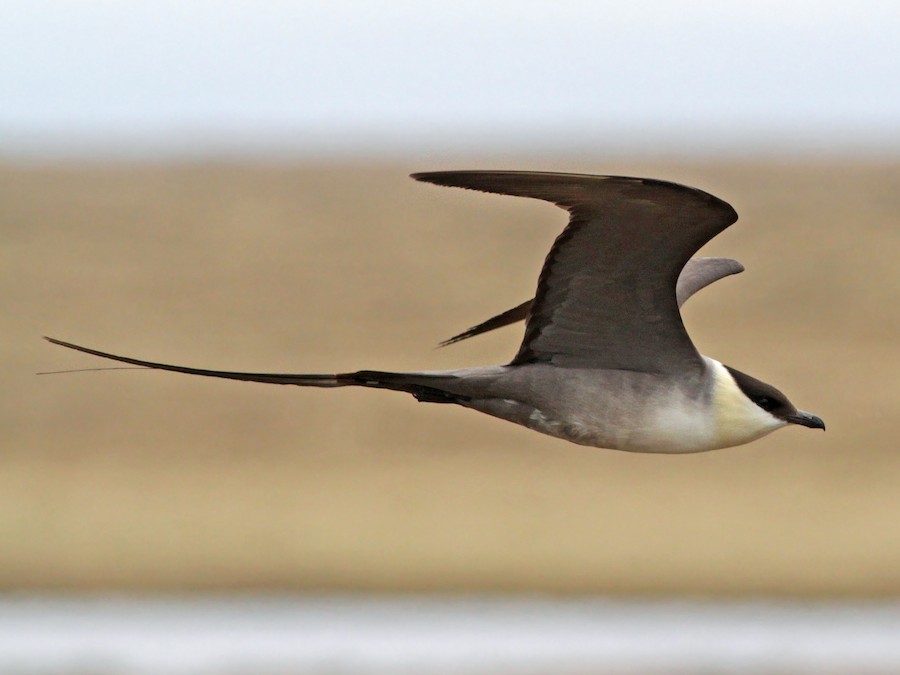

With its slender, elongated tail feathers,
smooth, gliding flight across open skies,
and a life forged in the harsh winds of the Arctic seas,
the long-tailed skua is a seabird that looks tern-like at first glance but actually belongs to the skua group—renowned for aerial mastery and a strikingly unique ecology.
🧬 What Is the Long-tailed Skua?
The long-tailed skua (Stercorarius longicaudus) belongs to the skua family. Its most distinctive feature is the very long central tail feathers of breeding adults, making it the most graceful and slender-looking of all skuas.
- Class / Order / Family: Aves / Charadriiformes / Stercorariidae
- Key traits
- Long, pointed tail feathers
- Exceptional gliding and maneuverability
- Breeds in the Arctic
- Famous for kleptoparasitism (“pirate” behavior)
👉 A bird that combines elegant form with fierce survival strategies.
🌍 Distribution & Habitat
The long-tailed skua is a long-distance migratory seabird, traveling between polar regions and the open ocean.
- Breeding grounds
- Arctic tundra of Canada, Greenland, and Siberia
- Wintering grounds
- Open oceans of the Southern Hemisphere
- Habitats
- Breeding season: terrestrial Arctic tundra
- Non-breeding season: pelagic (open ocean)
🌍 It is a true global traveler, moving between the far north and far south of the planet.
👀 Appearance & Physical Characteristics
- Length: About 38–58 cm (including tail)
- Wingspan: About 110–125 cm
- Appearance
- Pale gray body with a dark cap
- Extremely long central tail feathers (breeding plumage)
- Slim, lightweight build
- Non-breeding plumage
- Shorter tail and paler coloration
✨ During the breeding season, it is considered one of the most elegant silhouettes among seabirds.
🍽️ Diet & Hunting Strategies
The long-tailed skua is carnivorous.
Main foods
- Small fish
- Eggs and chicks of other seabirds
- Insects (especially on tundra during breeding)
- Food stolen from other seabirds
👉 It is especially well known for kleptoparasitism, chasing other birds midair until they drop their catch.
🧠 Behavior & Temperament
- Highly agile and intelligent
- Exceptional aerial control and rapid direction changes
- Extremely aggressive in nest defense
- Will dive-bomb predators—and even humans—near its nest
🐦 Small in size, but fearless when protecting its territory.
🐣 Reproduction & Life Cycle
- Breeding season: Arctic summer
- Nest
- A shallow scrape on the ground
- Clutch size
- Usually 2 eggs
- Parental care
- Both parents incubate and raise chicks
- Lifespan
- Around 15–20 years or more
🕊️ Cooperative parenting is essential for survival in the harsh Arctic environment.
🌱 Ecological Role
- Links marine and terrestrial food webs
- Regulates populations of fish and seabirds
- Transfers energy between tundra and ocean ecosystems
🌍 The long-tailed skua serves as an important ecological connector between land and sea.
⚠️ Threats & Conservation
- Climate change affecting Arctic breeding grounds
- Marine pollution
- Declining food availability
👉 As a long-distance migrant, its survival depends on global-scale conservation efforts.
🧡 Why the Long-tailed Skua Is Special
✔️ The most elegant-looking of all skuas
✔️ An extreme long-distance migratory bird
✔️ Unique “pirate” feeding strategy
✔️ A powerful symbol of Arctic wildlife
The long-tailed skua is:
🐦 A graceful line drawn across Arctic skies,
🐦 A seabird where beauty and ferocity coexist, and
🐦 A traveler connecting the planet’s poles.
As it cuts through icy winds with effortless flight, the long-tailed skua carries a quiet story of endurance—one written across the most demanding landscapes nature has to offer.
댓글 남기기